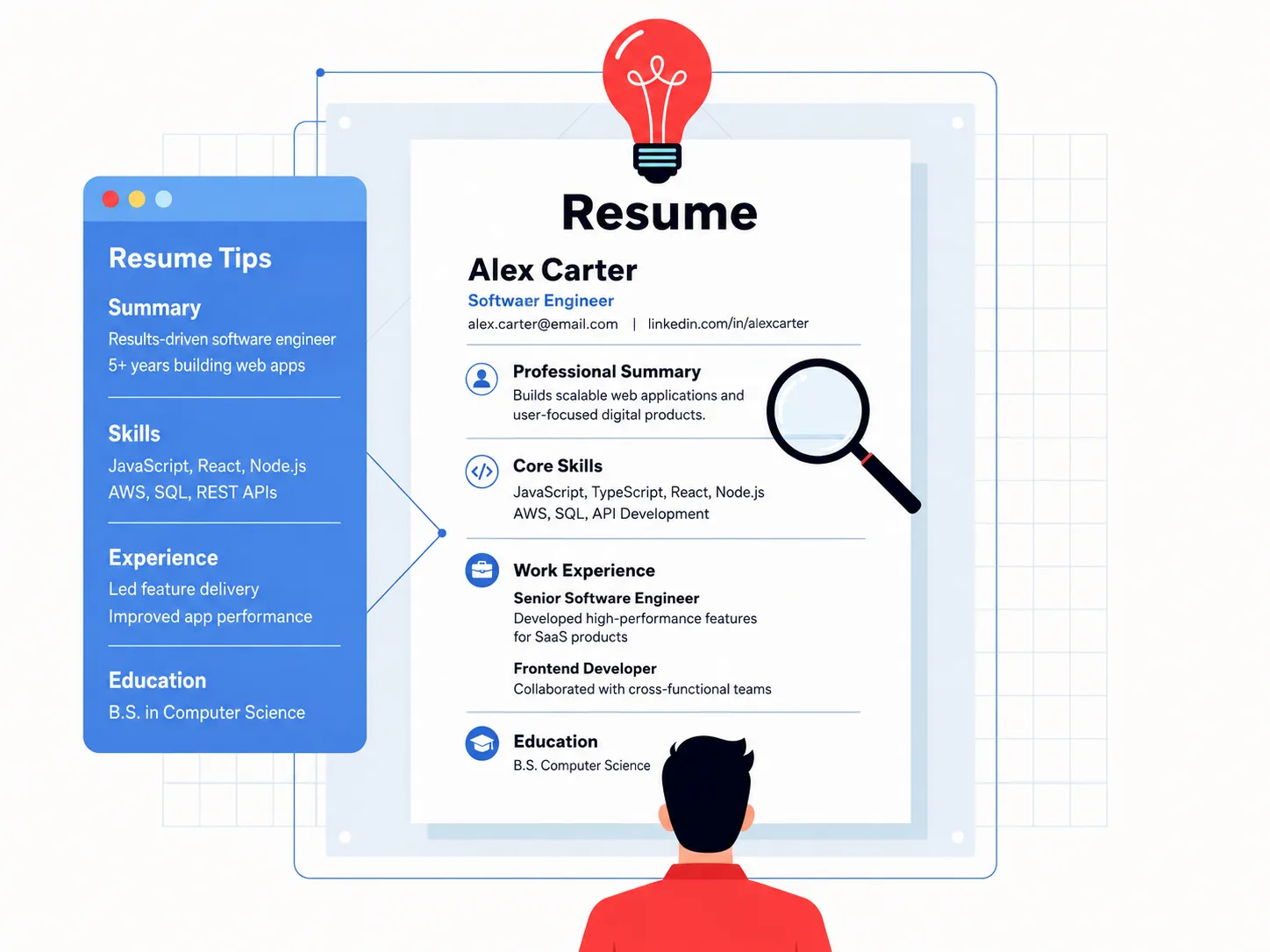
You can be a strong engineer and still hear nothing after applying. Frustrating, right?
The problem may not be your experience. It may be how that experience appears on your software engineer resume. Recruiters need to understand your fit quickly. If your best work is buried under vague language, long skill lists, or messy formatting, they may move on before seeing what you can do.
Here are seven common mistakes — and how to fix them.
1. Using the Same Resume for Every Job
Sending one resume to 30 companies is easy. But does it show why you fit each role?
You do not need to rewrite everything. Adjust your summary, reorder your skills, and highlight the projects most relevant to the job description. A backend role should not lead with your occasional UI work.
One of the most useful software engineer resume tips is simple: put the strongest evidence where recruiters can see it first.
2. Turning Your Resume Into a Giant Tech Stack
JavaScript. Python. React. AWS. Docker. Kubernetes. PostgreSQL. And 25 more tools.
Looks impressive — but what does it prove?
A long list does not show how well you know each technology. It may even make recruiters question whether you have deep experience or brief exposure.
Keep your software engineer skills for resume section focused. Then connect important technologies to real projects and results. Context is more convincing than keyword volume.
SmartRecruiters’ Recruitment Benchmarks 2025 report found that roles receive a median of 73 applicants per hire globally, with technology roles drawing roughly 51% more applicants than the average — often around 110 applicants per opening. In that volume, a resume that clearly signals fit for the specific role has a real advantage over one that reads as generic.
3. Listing Responsibilities Instead of Achievements
“Responsible for developing backend services” tells readers what your job required. It does not show whether you did it well.
After: Built and optimized Node.js services that reduced average API response time by 30%.
Notice? The second version shows action and impact. Whenever possible, include numbers related to speed, scale, reliability, revenue, cost, users, or delivery time.
Here is another example:
Before: Responsible for maintaining the company’s cloud infrastructure. After: Migrated legacy infrastructure to AWS, cutting monthly hosting costs by 25% and eliminating recurring downtime.
Your technical resume should answer one question: what became better because of your work?
4. Making Your Contribution Unclear
Software is built by teams. Still, recruiters need to understand what you did.
“Developed a platform used by 100,000 customers” sounds good, but did you design the architecture, build one feature, lead a migration, or fix production issues?
Another example:
Before: Part of a team that built a customer dashboard. After: Designed and built the analytics dashboard’s front-end, cutting page load time by 40% for over 10,000 daily users.
Use clear verbs such as built, designed, migrated, optimized, and led. Give credit to the team while making your ownership visible.
5. Writing a Generic Professional Summary
Are you a “results-driven, passionate team player”? So is nearly everyone else, according to their resume.
Generic phrases waste space. A useful summary should quickly communicate your experience level, specialization, core technologies, and industry exposure.
For example:
Backend software engineer with six years of experience building scalable Node.js and AWS applications for fintech and healthcare products.
That is specific. It gives the reader a reason to continue.
6. Ignoring Readability and Structure
Your resume is not a design competition. It is a communication tool.
A good software engineering resume should be easy to scan in seconds and still provide useful detail.
- Use standard section headers (Experience, Skills, Education) instead of creative labels that recruiters have to decode
- Keep bullet points short — one line or two at most — so each achievement is easy to scan
- Stick to a clean, familiar font and consistent sizing throughout the document
- Leave enough white space between sections so the page doesn’t feel cramped
- Avoid dense paragraphs; break information into bullets wherever possible
- Skip heavy graphics, columns, or icons that can confuse applicant tracking systems and readers alike
Keep formatting consistent — same date format, same bullet style, same spacing — across every section. Dense paragraphs, tiny fonts, unusual section names, and heavy graphics make a strong background harder to evaluate. Use familiar sections, short bullet points, and enough white space.
Does readability really matter?
Readability isn’t a cosmetic concern — it reflects how resumes actually get reviewed. Research from Tufts University found that recruiters typically spend just six to eight seconds on a first scan of a resume, often without the technical depth to evaluate skills in detail, leaning instead on structure and clarity to form a quick impression.
A clean, well-organized layout gives your strongest qualifications a chance to register in that narrow window.
7. Adding Skills You Cannot Defend
Would you feel comfortable answering technical questions about every tool listed on your resume?
If not, reconsider whether it belongs in your main skills section. Adding every framework you touched once may match more keywords, but it also creates expectations you may not meet.
Be honest about your level. Credibility matters more than appearing to know everything.
Final Check Before You Apply
A strong software engineer resume does not need to tell your entire career story. It opens with two or three achievements chosen specifically because they match the target role, with each one backed by a concrete result. Recruiters read that level of specificity as proof of qualification — a broad career summary does not achieve the same effect.
Ask yourself:
- Does my resume open with 2-3 achievements that directly match this role, not a generic career recap?
- Is each achievement backed by a concrete result (a number, metric, or clear outcome)?
- Have I removed responsibility-only statements like “responsible for” or “worked on” in favor of what actually changed because of my work?
- Is my contribution clear on every team project — did I design it, build it, migrate it, or fix it?
- Is my skills section focused on tools I can confidently discuss in an interview, not a keyword dump?
- Does my professional summary state my experience level, specialization, core technologies, and industry focus — not generic phrases like “results-driven team player”?
- Is the resume tailored to this specific job posting, even if only the summary and skill order changed?
- Can I scan my own resume in under 8 seconds and still identify my strongest qualification?
- Would I feel comfortable answering a technical question about every skill I’ve listed?
A few focused edits may turn more applications into real interviews.
Build a Stronger Software Engineer Resume with UnitedCode
Looking for the right project — and a better way to present your experience?
At UnitedCode, we do more than connect software engineers with projects that match their skills and career goals. We analyze your technical background, identify the experience that best demonstrates your value, and transform it into a clear, differentiated resume format designed for technical hiring.

We do not invent achievements or add skills you cannot defend. We make the experience you already have easier for recruiters and hiring managers to understand.
Looking for a job? Explore new career opportunities by visiting our vacancies page. Alternatively, create your own resume using the innovative, data-driven format available on the unitedcode.ai platform.
Prepared and written by Yuliia Romanova, Co-Founder and CEO of UnitedCode, Certified Scrum Product Owner (CSPO), Certified ScrumMaster I & II (CSM), and female entrepreneur.
FAQ
How long should a software engineer resume be?
One page is often enough for junior candidates, while experienced engineers may use two pages to convey relevant content.
Should I include every technical skill?
No. Include the skills most relevant to your target roles and the ones you can discuss confidently.
Should I tailor my resume for every job?
Yes — but do not start from scratch. Update your summary, skills order, and most relevant achievements for the position.
What if I do not have exact numbers to quantify my achievements?
Use the best reasonable estimate. Even an approximate figure — such as team size, request volume, or time saved — shows scale and impact better than a purely descriptive statement.
Should a software engineer resume include a career objective?
A short professional summary is usually more effective than a generic objective statement. It should highlight your experience level, core technologies, and area of specialization within a few lines.
How many projects should I include on my resume?
Focus on two to four projects that best demonstrate skills relevant to the role you are applying for. Fewer, well-explained projects are more convincing than a long list with little detail.